Agensh: Scaling Organizational Intelligence to 1,024 Agents

Zhihao Zhan*Ting Song*Li DongShaohan HuangJianxun LianYan XiaFuru Wei

Microsoft Research

*Equal contribution   Corresponding authors

Agensh is a scalable, self-organized multi-agent harness without a central orchestrator.
Concurrent workers gather context, claim sub-tasks, share findings, verify, and merge progress asynchronously
through a lightweight agentic organization infrastructure, consisting of a shared workspace, a message interface, and shared context.

1 → 1,024agents cooperating
on one shared repository
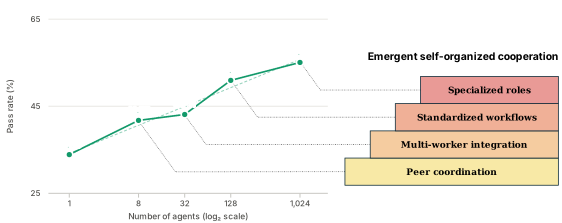
33.89% → 55.06%final test pass rate on pandoc
(6h, no Internet)
+62%pass rate relative gain,
1 → 1,024 agents on pandoc
Final test-pass rate on pandoc rising from 33.89% with 1 agent to 55.06% with 1,024 agents, annotated with the cooperation that emerges at each scale: peer coordination, multi-worker integration, standardized workflows, and specialized roles
Figure 1. Scaling from 1 to 1,024 agents on building pandoc from scratch under a 6h budget without Internet access. Final test-pass rate rises from 33.89% for 1 agent to 55.06% for 1,024 agents. As the organization grows, emergent self-organized cooperation gradually expands from peer coordination to multi-worker integration, standardized workflows, and specialized roles.
Loading replay…

How Agensh Scales

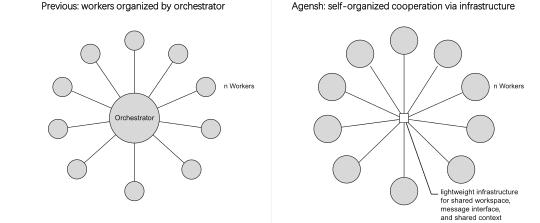
Left: n workers connected to a central orchestrator. Right: n workers connected through a small lightweight infrastructure node for shared workspace, message interface, and shared context
Figure 2. Comparison of multi-agent systems. In previous work, cooperation among agent workers is constrained by the capacity of a central orchestrator. In Agensh, self-organized workers share their state and communicate their progress through the lightweight agentic organization infrastructure.

Main Results

With the same model, underlying Copilot harness, and 6h budget, scaling self-organized concurrent workers improves both the final score and the time needed to achieve a given test-pass rate.
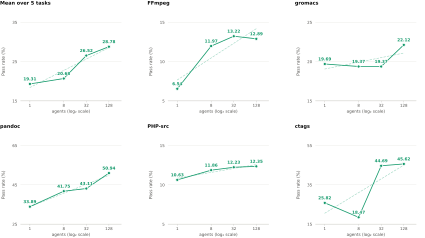
Final test-pass rates for 1, 8, 32, and 128 agents on FFmpeg, gromacs, pandoc, PHP-src, and ctags
Figure 3. Scaling from 1 to 128 agents on the five hardest ProgramBench tasks (FFmpeg, gromacs, pandoc, PHP-src, ctags) under a 6h budget. Mean final test-pass rate rises from 19.31% for 1 agent to 28.78% for 128 agents.
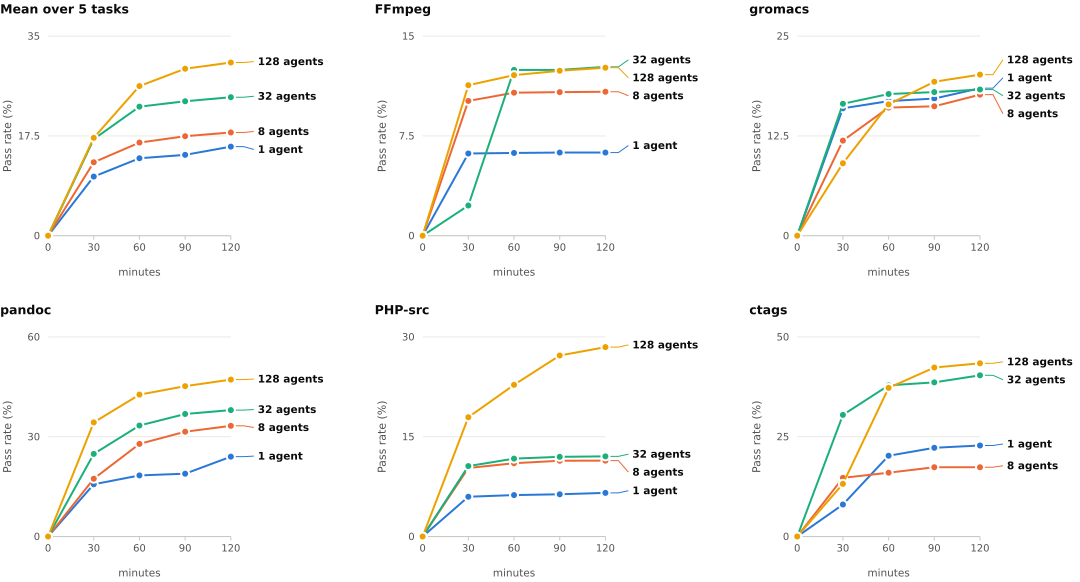
Test-pass rate over the first two hours for 1 to 128 agents on each of the five tasks
Figure 4. Test-pass rates over time with 1 to 128 agents during the first 2h of the 6h runs. Larger organizations generally achieve higher test-pass rates earlier: on pandoc, 128 agents exceed 30% at the 30-minute checkpoint, while 32 and 8 agents first do so at 60 and 90 minutes.

Citation

@article{zhan2026agensh,
  title   = {Agensh: Scaling Organizational Intelligence to 1,024 Agents},
  author  = {Zhan, Zhihao and Song, Ting and Dong, Li and Huang, Shaohan and Lian, Jianxun and Xia, Yan and Wei, Furu},
  journal = {arXiv preprint arXiv:2609.26781},
  year    = {2026}
}